

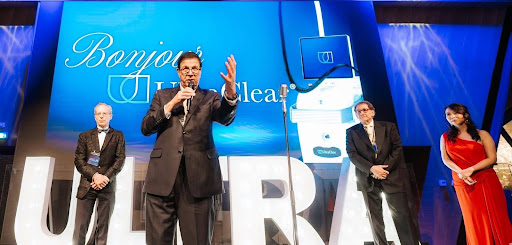
Shlomo Assa has a piece of advice he gives consistently, and it is not the kind that fits on a motivational poster. Listen. Observe. Analyze. Understand the economics of the problem before you touch the solution. Only then, be creative. It is a sequence, not a slogan, and it is the operational logic behind a career that has produced 22 patents, four successful company exits, and some of the most widely used laser platforms in the history of medical aesthetics.
Most entrepreneurs learn one or two of those steps well. Assa has spent more than four decades practicing all of them in sequence, across multiple industries, and the compounding effect of that discipline is visible in what he has built.
He started in laser science and engineering, earning a Master of Science in Lasers and Optics from Tel Aviv University and a Bachelor of Science in Mechanical and Electrical Engineering from Technion in Haifa. The academic training gave him technical fluency, but the real education came from working in environments where imprecision was not tolerated. His early career in industrial and pharmaceutical laser applications, developing coding systems for moving production lines and building the first high-definition laser imaging technology to reach more than 30 manufacturers globally, trained him to see problems in terms of their actual mechanics rather than their surface presentation.
That training shaped how he built companies. Four of them, each launched around a specific technical gap that Assa had identified through observation rather than market research alone. Each sold to buyers who recognized that the invention at the center of the business was the real value. LaserInk, acquired by Dover, a Nasdaq-listed company, was among them. The exits were validations of the process as much as they were financial outcomes.
The process produced its most visible results at Syneron-Candela, where Assa served as General Manager and Chief Technology Officer and helped triple the company’s revenue in four years. The platforms he invented there, CO2RE and PicoWay, are now gold standards for facial rejuvenation in clinical aesthetic practice worldwide. GentleMax Pro Plus, which he originated, gave practitioners a more capable hair removal system when it launched in 2019. The combined commercial and clinical impact of those products represents the most publicly recognized chapter of his career, though Assa would note that the same method that produced them was already at work decades earlier, in much less visible settings.
Acclaro Corporation and the UltraClear Laser are the current application of that method. The aesthetic industry, as Assa sees it, has accumulated significant technical capability over the past two decades and is now largely deploying that capability in increasingly narrow ways. The questions being asked of aesthetic technology are not ambitious enough, and the gap between patient expectations and device performance is wider than the industry’s marketing would suggest. Acclaro exists to close that gap, specifically in the area of total skin health and longevity, where Assa believes the real unmet need currently lives.
The lesson he draws from all of it is one that applies well beyond laser technology or medical aesthetics. Hard work is necessary but not sufficient. What separates the businesses that change an industry from the ones that merely participate in it is the quality of the question being asked at the beginning. Assa has spent 40 years asking better questions than the market expected. Acclaro is the latest answer.