


Have you ever finished a long day at your desk, stood up, and felt that deep, burning ache in your neck and shoulders? Or maybe you’re recovering from a “tennis elbow” injury after too much time on the court? All these common pains—from the guitar player’s strained forearm to the nurse’s chronic low back pain—share a root cause: the overuse of some muscles and the simultaneous stiffening of others.
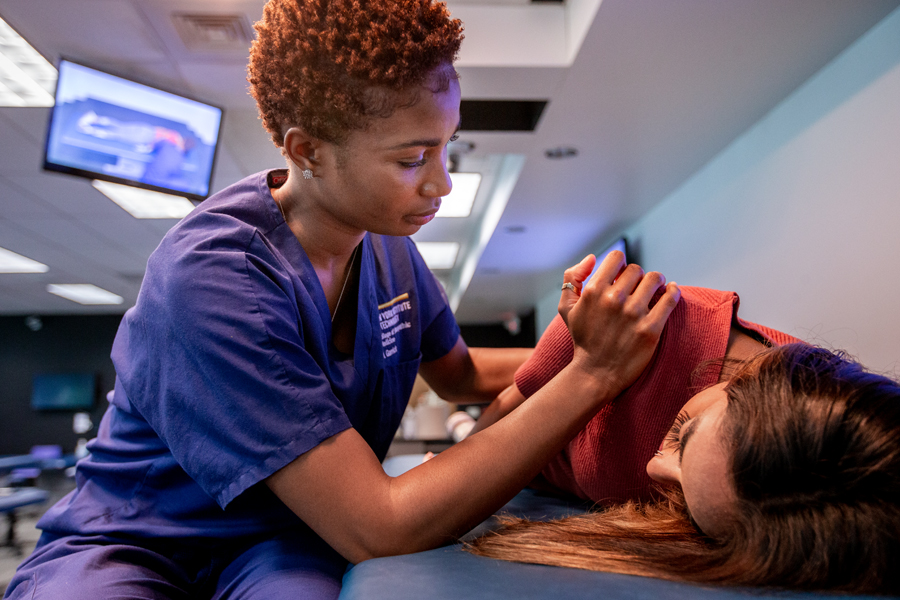
Osteopaths use Osteopathic Manipulative Treatment (OMT), a hands-on, whole-person approach to restore motion and relax muscles by finding the root cause of pain. Future DOs master this deep anatomical knowledge and technical skill through foundational training, culminating in the rigorous COMLEX Level 1 exam.
From Textbooks To Touch: Why the COMLEX Is More Than Memorization
You might think of an exam like this as just checking off boxes on a spreadsheet, but honestly, it’s much more crucial than that. COMLEX Level 1 is the proving ground where a DO student’s detailed understanding of anatomy, physiology, and pathology is rigorously tested.
COMLEX Level 1: Building The Osteopathic Doctor
The COMLEX Level 1 is crucial; it’s the proving ground where a DO student’s detailed understanding of anatomy, physiology, and pathology is rigorously tested. It’s far more than memorization.
Why is COMLEX a Foundational Exam?
- Testing The “Why”: A DO must master the deep science behind the pain, such as fascial restrictions or a subtly rotated vertebra, rather than just seeing a muscle strain. The exam forces students to build an incredibly detailed, three-dimensional “Mental Map” of the human body.
- The OMT Component: Level 1 specifically tests the principles and application of Osteopathic Manipulative Treatment (OMT). This ensures that every future DO demonstrates competency in the core concepts necessary to perform OMT effectively and safely, offering patients this hands-on healing option.
Thinking Like A DO: The Whole-Person View
The osteopathic philosophy emphasizes that the body is a unit and that structure and function are interrelated.
- Connecting the Dots: The exam challenges students to think holistically. Instead of treating tennis elbow in isolation, the DO is trained to connect it to shoulder mechanics, posture, and overall stress levels.
- Healing Power: COMLEX science focuses on the body’s natural capacity for self-regulation and healing. Understanding the perfect working order of the neurological, circulatory, and musculoskeletal systems is essential for nudging the body back toward health.
Better Patient Care
The readiness achieved through the COMLEX directly translates to better patient care.
- Broader Toolbox: By integrating standard medical science with osteopathic principles, the future DO leaves medical school with a more comprehensive toolkit. They can prescribe medicine, but they also have OMT as a powerful, non-pharmacological treatment option.
- Clinical Competence: The high standard of foundational knowledge ensures that physicians entering clinical rotations offer a broader, more integrated set of diagnostic and treatment options from day one.
Summing Up:
The COMLEX Level 1 is a critical gatekeeper that defines the quality and future direction of the osteopathic profession. It ensures that the unique, hands-on, and whole-person philosophy that makes a DO so distinct and valuable is never lost.